
Hiring a Search Engine Marketing (SEM) agency is one of the quickest ways for a venture-backed or bootstrapped US startup to scale pipeline—or burn through quarterly cash reserves with zero pipeline to show for it.
The US market is unforgiving. Cost-per-click (CPC) rates across Google Ads and Microsoft Ads continue to climb in competitive verticals like B2B SaaS, fintech, enterprise services, and high-ticket direct-to-consumer. In this environment, basic keyword bidding and surface-level conversion tracking are not enough.
You need an agile growth partner that approaches paid search as an engineering and unit-economics discipline.
Here is the evaluation framework high-growth founders, Heads of Growth, and CMOs use to vet, select, and partner with a performance-driven SEM agency.
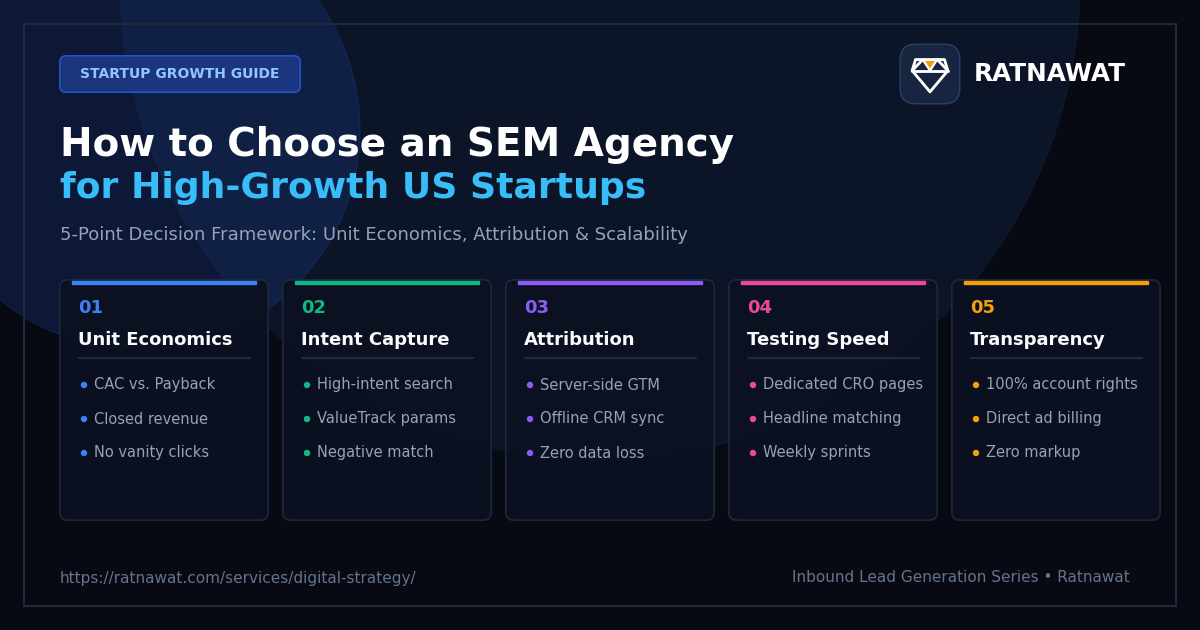
1. Look for Unit Economics Alignment (Not Vanity Metrics)
Traditional digital marketing agencies often highlight impressions, click-through rates (CTR), and top-of-funnel lead counts. For a scaling startup, these metrics hide critical inefficiencies.
An SEM partner must understand your full-funnel economics:
- Customer Acquisition Cost (CAC) by Channel & Campaign: Can they track blended vs. paid CAC down to specific ad groups?
- Payback Period: How quickly does gross margin from closed deals recover the paid search ad spend?
- Pipeline Velocity & Close Rates: Are they optimizing campaigns based on sales-qualified leads (SQLs) and closed-won revenue, rather than cheap form fills that waste your sales team’s calendar?
Full-Funnel Closed-Loop Conversion Flow:
- Ad Impression: High-intent search query matching.
- High-Intent Click: Targeted keyword and ValueTrack parameter capture.
- Landing Page: Message-matched conversion experience.
- SQL / Opportunity: Sales team qualification in CRM.
- Closed Revenue: Offline conversion data synced back to Google Ads for bid optimization.
When interviewing agencies, ask: “How do you adjust bidding strategies when lead volume is high but downstream sales conversion is low?” If their answer focuses purely on lowering cost-per-click rather than qualifying search intent and auditing conversion quality, move on.
2. Inspect Their Technical Tracking and Attribution Rigor
Modern search engine marketing lives and dies by data feed accuracy and attribution infrastructure. With browser privacy shifts, third-party cookie phaseouts, and multi-touch B2B buying cycles, surface-level pixel tracking is no longer sufficient.
A top-tier SEM agency must bring technical depth in:
- Server-Side Google Tag Manager (sGTM): Ensuring first-party data capture without browser data loss.
- Offline Conversion Imports (OCI): Feeding Google Ads and Microsoft Ads real CRM stage changes (e.g., Lead Created → Demo Completed → Deal Closed) using GCLID, GBRAID, and WBRAID identifiers.
- ValueTrack & UTM Hygiene: Standardizing naming conventions across campaigns to feed your business intelligence dashboards cleanly.
- Enhanced Conversions & Consent Mode Setup: Maximizing algorithmic smart-bidding efficiency while staying fully compliant.
Contextual Growth Check
Is your paid search account capturing high-intent pipeline or wasting spend on low-intent queries? Get a complete audit of your keyword architecture, negative lists, tracking hygiene, and landing page conversion flow from the team at Ratnawat Global.
👉 Request a Free Paid Search Audit & Strategy Review
3. Insist on 100% Account Ownership and Financial Transparency
A major red flag in the agency landscape is the “black box” model, where the agency runs campaigns out of their own master ad account or bundles ad spend with their management fees into a single invoice.
Before signing an engagement agreement, confirm the following standards:
- Direct Billing with Ad Networks: Your company credit card should be billed directly by Google Ads, Microsoft Advertising, or LinkedIn Ads.
- Master Admin Access: You retain primary admin rights and full account ownership. If the relationship ever ends, all historical campaign data, audience lists, ad copy, and tracking setups stay with your company.
- Transparent Fee Structure: The agency should charge a flat monthly retainer or a transparent base-plus-performance tier—never hidden spreads or marked-up CPCs.
4. Evaluate Landing Page CRO and Experimentation Speed
Search campaigns only perform as well as the landing pages they send traffic to. Even the most targeted keyword bidding strategy will fail if traffic lands on a generic homepage with high bounce rates.
Your agency should take ownership of the post-click experience:
| Feature | Average Agency | Performance SEM Partner |
|---|---|---|
| Landing Page Strategy | Directs traffic to existing website pages | Builds dedicated, zero-distraction landing pages |
| Message Matching | Generic hero copy across all ad groups | Keyword-specific dynamic headline insertion |
| Testing Rhythm | Occasional copy tweaks | Continuous multivariate testing on forms, hooks, and social proof |
| Speed & UX | Overlooks mobile speed and layout shifts | Sub-2-second load times optimized for US mobile & desktop |
Ask prospective agencies for real examples of conversion rate optimization (CRO) tests they ran for similar clients and what impact those tests had on downstream cost-per-acquisition (CPA).
5. How to Structure Your First 90 Days with an SEM Partner
A well-structured onboarding sprint prevents lost momentum. Look for an agency that operates on a clear roadmap:
Days 1–30: Audit, Infrastructure & Foundational Cleanup
- Complete audit of historical account data, negative keyword lists, and search query reports.
- Full instrumentation review: verify tag firing, offline conversion mapping, and CRM pipeline sync.
- Competitive landscape analysis covering US search bidding patterns and competitor messaging.
Days 31–60: Campaign Restructure & Rapid Validation
- Launch rebuilt intent-tiered search campaigns (exact match core themes, tight phrase match, structured brand defense).
- Deploy dedicated landing pages with message-matched conversion funnels.
- Establish daily budget pacing controls and query negation cadences to eliminate budget waste.
Days 61–90: Algorithmic Scaling & Bid Optimization
- Transition validated ad groups to target CPA (tCPA) or target ROAS (tROAS) bidding using enriched CRM conversion signals.
- Expand into adjacent high-intent long-tail keywords and cross-channel remarketing.
- Deliver executive-level pipeline attribution reporting for board and leadership meetings.
Drive Qualified US Pipeline with Ratnawat Global
At Ratnawat Global, we build and manage full-funnel search engine marketing campaigns that prioritize closed revenue, low payback windows, and clean attribution. Whether you are launching paid search for the first time or restructuring an underperforming multi-tier account, our team brings the technical precision and growth discipline needed to scale across US markets.
What You Get in Our Initial Strategy Session:
- Comprehensive audit of your current Google Ads and Microsoft Ads structure
- Identification of budget leaks and irrelevant query matching
- Landing page conversion rate and message-match analysis
- Custom growth roadmap tailored to your target CAC and pipeline goals
👉 Fill out our short inquiry form with your website URL and growth target. Our strategy team will review your account and get back to you within one business day.
Frequently Asked Questions (FAQ)
How much should a US startup spend on SEM monthly before seeing reliable data?
Most B2B and high-growth startups need a minimum monthly ad spend of $3,000 to $7,500 to generate sufficient statistically significant conversion volume in competitive US search auctions. This budget allows the ad network’s bidding algorithms to exit the learning phase within 2 to 4 weeks while testing multiple keyword themes and landing page variations.
How quickly should an SEM agency show measurable results?
While technical tracking and campaign restructuring happen within the first 14 to 30 days, reliable efficiency gains and baseline CAC stabilization typically materialize between days 45 and 75. Search engine bidding algorithms require consistent conversion history to optimize effectively.
What is the difference between an SEM agency and an SEO agency?
SEM (Search Engine Marketing) focuses on immediate, paid search capture through platforms like Google Ads and Microsoft Ads, delivering direct traffic as long as campaigns run. SEO (Search Engine Optimization) builds long-term organic authority and compounding search rankings. High-growth startups often pair both strategies to capture immediate high-intent buyers while building sustainable organic distribution over time.
Should my startup manage Google Ads in-house or hire an agency?
If your team has in-house performance marketing specialists with dedicated bandwidth for weekly query negative scrubs, landing page testing, and tracking maintenance, an internal team is viable. However, if paid search is managed as a part-time task by a generalist marketer or founder, partnering with an experienced performance agency avoids expensive learning curves and accelerates time-to-pipeline.